Uzuncaburç (Diokaisareia): The Temple of Zeus Olba and the Forgotten Holy City of Cilicia
In the Taurus Mountains, 70 kilometers north of Mersin, at an altitude of about 1,200 meters above sea level, lie the ruins of one of Turkey’s most atmospheric ancient cities—Uzuncaburç, known in antiquity as Diokaisareia. At its heart lies the 3rd-century BCE Temple of Zeus Olba, one of the oldest Corinthian temples in the world. Surrounding it are city walls, monumental gates, a basilica, tombs, a Roman theater, and a solitary tall tower that gave the site its modern Turkish name, “Uzuncaburç”—“tall tower.” The silence of the mountain forests, the thin air, and the clear Anatolian sky make a visit here one of the most meditative archaeological experiences in Turkey.
History
The earliest phase of the settlement is associated with the theocratic state of Olba, founded, according to legend, as early as the 2nd millennium BCE by the descendants of the legendary Trojan priest Ajax (Aias), son of Teucer. The state was ruled by a dynasty of hereditary priest-kings bearing the name Teucer or Ajax, who worshipped primarily Zeus Olbios. Olba controlled the mountainous regions of Cilicia Tracheia and held the coastal cities under its authority.
Uzuncaburç itself is the sacred city (hieron) of Olba, located a few kilometers from the capital of Olba proper (the modern village of Ura). At the turn of the 4th–3rd centuries BCE, a magnificent temple of Zeus was built here—one of the first in history to be constructed in the Corinthian order. Its design is attributed to one of the early masters of Hellenistic architecture; some researchers associate the project with Seleucus I Nicator.
During the Roman period, the city was renamed Diokaisareia (“City of Zeus Caesar”) in honor of the imperial cult and received the status of a polis. This was the period of its greatest prosperity—the 1st–3rd centuries CE—when the city walls, monumental gates, a basilica, a nymphaeum fountain, and numerous tombs were built. During the Byzantine era, the Temple of Zeus was converted into a Christian basilica, and the city itself became a bishopric.
Following Arab raids in the 7th–9th centuries and the shift in trade routes, the city fell into decline and was gradually abandoned. The area became part of the Seleucid Empire, the Armenian Kingdom of Cilicia, and later the Ottoman Empire. The modern village of Uzuncaburç developed near the ruins and existed for a long time as a small rural settlement.
Systematic archaeological work began in the early 20th century; German, Austrian, and Turkish expeditions explored the temple and the city. Uzuncaburç has been included on the UNESCO World Heritage Tentative List (since 2014).
Architecture and What to See
Temple of Zeus Olba
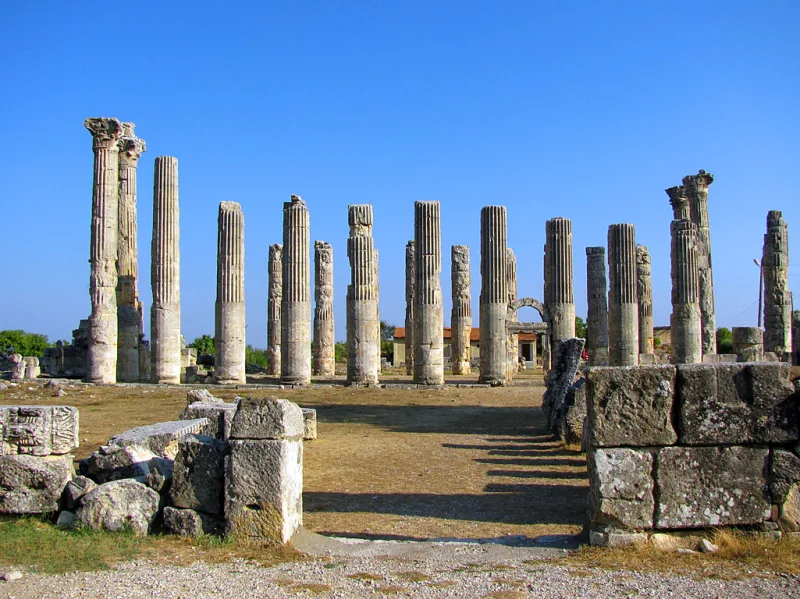
The main treasure of Uzuncaburç is the Temple of Zeus Olba, built in the early 3rd century BCE (around 295–280 BCE). It is one of the oldest known Corinthian temples in the world—along with the Temple of Apollo at Bassae and the Cyclopean temples of Athens. The platform measures approximately 21 × 40 meters; the building was once surrounded by a peristyle of 30 Corinthian columns (6 × 12), of which about half remain today—standing about 10 meters tall. The capitals display an early form of the Corinthian order with relatively simple acanthus foliage.
In the 5th–6th centuries CE, the interior of the temple was converted into a Christian basilica: an apse and a narthex were added, and the layout of the cella was altered. This is a rare example of an ancient temple that continued to serve as a religious center for nearly a millennium—first as a pagan temple, then as a Christian one.
The High Tower (Uzuncaburç)
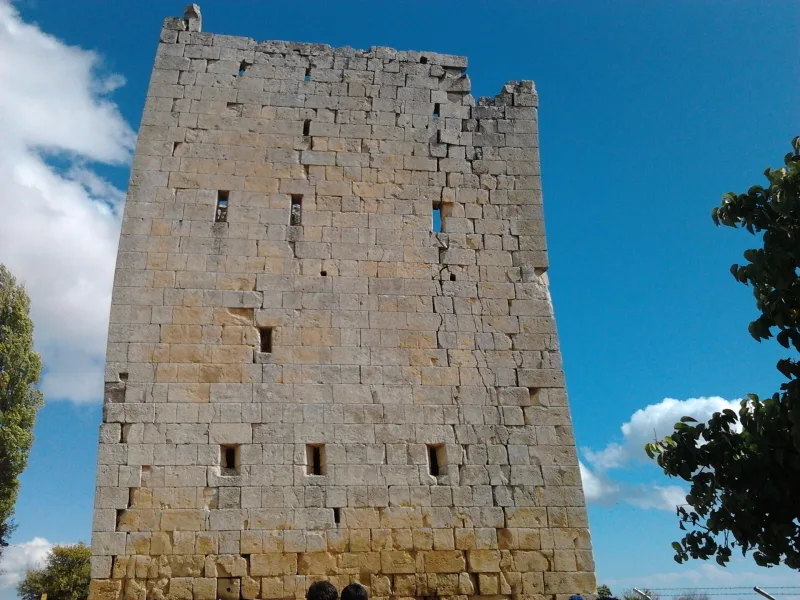
A few hundred meters north of the temple stands the famous “tall tower”—a five-story Hellenistic military watchtower about 22 meters high. It is one of the best-preserved towers of its kind in Turkey. It is this tower that gave the modern village its name, Uzuncaburç (“High Tower”). From the top level (the internal staircase is partially preserved), a panoramic view of the Taurus Mountains opens up.
Monumental Gate
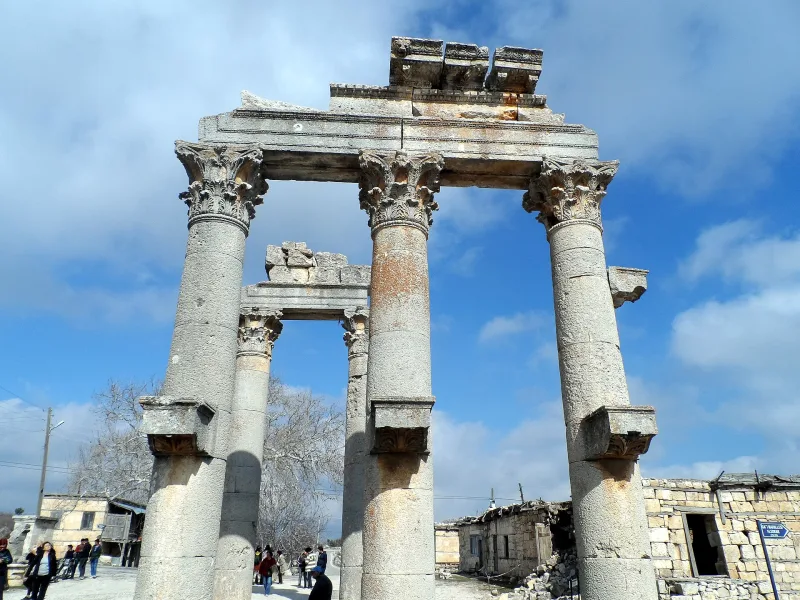
The city’s northeast gate (2nd century CE) is one of Uzuncaburç’s most impressive monuments. It is an arched propylon in the form of a triumphal arch, flanked by Corinthian columns and adorned with a sculpted cornice. The gate marks the beginning of the city’s main street.
City Wall and Streets
Significant sections of the city wall from the Hellenistic and Roman periods have survived, laid out in a regular grid pattern. The main street (cardo) runs from the northern gate to the Temple of Zeus; along it are fragments of colonnades, a nymphaeum fountain, and the remains of public buildings.
Theater and Basilica
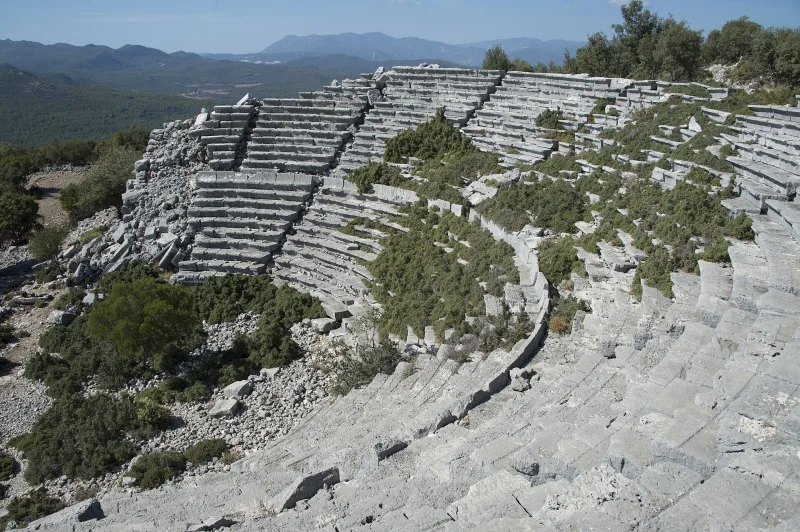
A small Roman theater (2nd century CE) is carved into the hillside and seats approximately 2,500 spectators. The tiers of the cavea and fragments of the scaenae frons have survived. A Byzantine basilica (5th–6th centuries) is located just off the Temple of Zeus.
Tombs and Necropolises
Numerous Roman and Hellenistic tombs are located around the city and in the surrounding area—monumental mausoleums carved into the rocks in the form of small temples and massive sarcophagi. One of the most famous is a mausoleum with two pediments in the Hellenistic style, located on the road to the temple.
Interesting facts
- The Temple of Zeus in Uzuncaburç is one of the oldest Corinthian peripteral temples in the world; its construction dates to a time when the Corinthian order was just emerging as an independent architectural system.
- The city of Olba, capital of the state of the same name, is located just 4 km southeast of Uzuncaburç (in the village of Ura) and was connected to it by a sacred road.
- The priest-kings of Olba bore the Greek names Theucus and Ajax for several centuries—an extremely rare form of hereditary theocratic rule in the ancient world.
- In the Roman census, Uzuncaburç is mentioned as Diokaisareia—“the city of Zeus-Caesar”—reflecting the syncretic fusion of the cult of Zeus Olba and the cult of the emperor.
- Uzuncaburç has been on UNESCO’s tentative list since 2014 and is actively being studied by Turkish and international archaeological missions.
How to get there
Uzuncaburç is located in the Silifke district of Mersin Province, in the Taurus Mountains, approximately 30 km north of the coastal town of Silifke and 70 km west of the center of Mersin. The road winds along a serpentine route, climbing from sea level to 1,200 meters—an adventure in itself, with magnificent views.
By car, the drive from Silifke to Uzuncaburç takes about 45 minutes (30 km). From Mersin, it takes about 1.5 hours (90 km). Renting a car is the most convenient option; public transportation in the mountains is irregular—dolmuşes from Silifke run a few times a day, so it’s best to check the schedule in advance.
The nearest airports are Adana Şakirpaşa (ADA, 200 km) and Hatay (HTY, 270 km). Regular buses run from Adana or Mersin to Silifke (1.5–2 hours); from there, take local transport or a taxi.
Tips for travelers
Uzuncaburç is an open-air archaeological park accessible year-round. Admission is charged but inexpensive; it is open from 8 :30 to 5 :00 (in winter) or until 7 :00 (in summer). Check the opening hours before your trip—they may be extended during peak season.
The best time to visit is late spring and fall (April–June, September–October). In summer, it’s cooler in the mountains than on the coast, but the sun is strong during the day. Snowfall occurs in winter; the road can become dangerous at times. Wear comfortable shoes—the grounds are rocky and uneven, and you’ll need good traction to climb the tower.
There are no cafes, shops, or restrooms of professional standard on the grounds; the village has a few small snack bars and tea houses. Bring water and a snack with you. Allow 2–3 hours for a thorough visit: the Temple of Zeus, the tower, the gates, the mausoleums, and the views will take exactly that long.
It’s convenient to combine this visit with a drive along the winding road through the Taurus Mountains, a stop in Olba (Ura) to explore the ruins of the ancient capital, and a descent to the coast with a stop in Silifke (fortress, Selçuk Han Palace). Silifke is historically linked to the death of Emperor Frederick I Barbarossa, who drowned in the Göksu River in 1190.
Photographers are in for a real treat: the Temple of Zeus with its Corinthian columns against the backdrop of pine forests and the Anatolian sky—one of the most picturesque ancient sights in Turkey. The best light is in the morning and in the first hours after sunrise, when the warm sun glides across the temple’s western facade.